2026-03-25
When AI Becomes a Key to National Power: ICI Invites International Scholar to Explore Strategic Space for Middle Powers
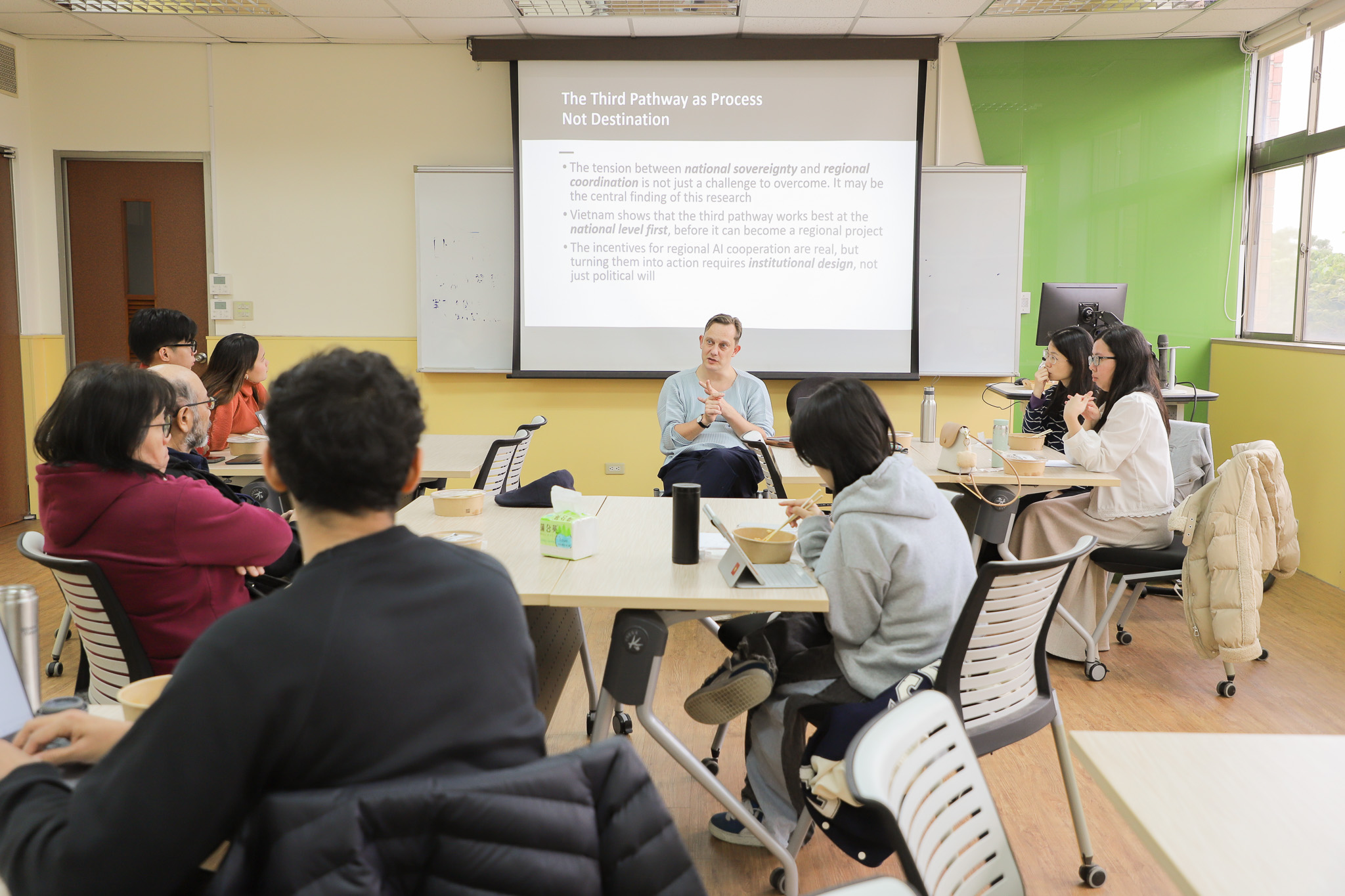
In response to the rapid development of artificial intelligence (AI) and the global challenges it brings to competition and governance, the International College of Innovation (ICI) at National Chengchi University hosted a special lecture titled “The Third Pathway: Middle Powers and AI Governance & Development” on March 13 at the International Building. The lecture was open to all NCCU faculty and students. The event featured Professor Tobias Burgers from Fulbright University Vietnam as the keynote speaker, with Assistant Professor Yung-Yu Tsai from ICI serving as the respondent; Associate Professor Tzu-Chi Ou and Associate Professor Hsin-Tse Lu from ICI were also in attendance, joining faculty members and students in exploring the development strategies and governance choices facing middle powers in the AI era.
The lecture focused on the current global AI landscape, which is largely shaped by a “G2” dynamic dominated by the United States and China. Professor Burgers emphasized that AI is no longer merely a technological issue, but a critical factor reshaping international politics, economics, and security. From transformations in the labor market to military decision-making and international relations, AI is redefining how nations compete and position themselves. Under such circumstances, many middle powers are facing increasing pressure to “choose sides” between the U.S. and China.
In response, Professor Burgers introduced the concept of a “third pathway,” arguing that middle powers do not necessarily have to align exclusively with one superpower. Instead, they can maintain technological autonomy and policy flexibility through strategic cooperation and balanced engagement. He illustrated this approach with the example of Vietnam’s leading technology company, FPT, which collaborates with U.S. firms such as Nvidia and Intel while also engaging with Chinese companies including Alibaba and Tencent. Through such cross-bloc partnerships, Vietnam is able to integrate technologies and diversify risks. This “hedging strategy” enables the country to maintain flexibility and autonomy in the global AI landscape, avoiding overdependence on a single technological system.
Responding from a policy and governance perspective, Assistant Professor Yung-Yu Tsai highlighted that AI has increasingly become a central issue in national security and strategic development. Using Taiwan as an example, she noted that the government has prohibited public sector agencies from using DeepSeek, a large language model developed in China, in order to prevent potential data leakage and risks to national security. This policy underscores the need for governments to carefully evaluate the sources of AI technologies and ensure data security while pursuing technological advancement.
Professor Tsai further pointed out that, compared to the Cold War era, when competition was primarily state-driven, the AI era places greater emphasis on the role of the private sector and cross-border collaboration. This shift provides middle powers with more strategic flexibility. However, she also cautioned that challenges such as data sharing, linguistic diversity, and institutional design remain significant obstacles to realizing a viable “third pathway.”
During the Q&A session, students raised questions regarding the development costs of localized large language models (LLMs) and whether governments should provide support. In response, Professor Burgers noted that countries with larger populations and stronger market foundations are better positioned to develop localized AI models. However, for resource-constrained countries such as Cambodia or Laos, such efforts may be financially unfeasible. In these cases, international organizations such as UNESCO could play a role in supporting “language preservation-oriented” AI development. While such initiatives may have limited commercial value, they are important for preserving cultural and linguistic diversity.
Students also expressed concerns about the concentration of personal data in the hands of technology companies, raising questions about governance and trust in the context of the “third pathway.” Professor Burgers responded that data governance and public trust will be critical to the future development of AI. As countries pursue technological progress, they must also establish appropriate institutional frameworks and regulatory mechanisms to safeguard citizens’ rights.
This lecture not only deepened participants’ understanding of global AI governance, but also inspired further reflection on the development strategies of middle powers. The International College of Innovation (ICI) also looks forward to continuing to organize a diverse range of lectures and exchange activities. Amid intensifying global competition in technology and AI, ICI aims to foster students’ critical thinking and global perspectives, encouraging deeper reflection and new ideas.







.png)
_1.png)
.jpg)